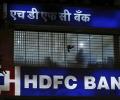
HDFC Bank's January-March quarter result, which came in-line with expectations, failed to enthuse investors. The reason? The management's decision to abstain from providing any specific growth guidance, and analysts' expectations of an arduous road to recovery. Analysts believe the path to normalisation of several growth metrics is unlikely to be a straightforward one, and the road to balance sheet realignment may be long.

Shares of low-cost airline IndiGo hit record high on the bourses soon after reports of pilot crisis at Vistara emerged. The development also saw airfares surge by around 25 per cent on select routes. Shares of IndiGo hit a lifetime high of ~3,68.5 on April 2, 2024, and has gained 2.4 per cent on the bourses in April.

Investors shunned shares of oil marketing companies (OMCs) on Friday as they feared that the government's decision to cut retail prices of petrol and diesel could hurt the companies' profit margins in the near term. On Thursday, the government announced that OMCs will reduce pump prices of petrol and diesel after a record 22 months, making them cheaper by Rs 2 per litre in the national capital. The changes were effective from Friday.

Micro-cap stocks are in the line of fire as market regulator Securities and Exchange Board of India (Sebi) is tightening its noose around investment in small-cap stocks. Given this, analysts suggest investors exit the segment, at least, for the time being. Independent market analyst, Ambareesh Baliga, for instance, said that regulators have gotten worried on the valuation front, though belated, which could prove to be the last straw on the camel's back.

After a stellar run on the bourses that saw tractor stocks rise up to 52 per cent, analysts are turning cautious on the sector as muted demand trends may weigh in the near-term. Total volumes in the tractor segment for the last three quarters of the current financial year (9MFY24) have remained weak with VST Tillers, Escorts Kubota, and M&M seeing declines of 21 per cent, 5 per cent, and 3 per cent year-on-year (Y-o-Y), respectively, during the period, amid patchy rainfall, delayed crop harvest, and lower reservoir level. Across industry, total domestic sales volume so far in the current financial year (April '23 to January '24) has declined 5 per cent Y-o-Y, as per Tractor Manufacturers Association (TMA).

Brokerages have maintained their ratings and target prices on FSN E-Commerce Ventures, the parent company of Nykaa, after the fashion and beauty online retailer posted in-line numbers during the October-December quarter (Q3) of financial year 2023-24 (FY24). They have, however, cut earnings before interest, tax, depreciation, and amortisation (Ebitda) estimates after weak demand weighed across line items in Q3. "While revenue growth was healthy at 22 per cent year-on-year (Y-o-Y), gross margins declined 90 basis points (bps), weighed by higher discounting in own brands and lower ad income.
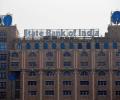
SBI Q3FY24 result review: A higher-than-factored weakness in the October-to-December quarter (Q3) results of State Bank of India (SBI), for financial year 2023-24 (FY24), has prompted brokerages to cut earnings estimates for the ongoing financial year. They, however, have maintained 'Buy' ratings on the stock, revising target price upwards in some cases, owing to the stock's recent underperformance relative to its peers.

Most analysts have downgraded the stock of SBI Cards and Payments (SBI Card) as the credit card issuer posted weak results during the December quarter (Q3) of financial year 2023-24 (FY24). The sub-par show, analysts said, was for the eighth straight quarter. With this, they have slashed their earnings estimates by as much as 20 per cent over FY24-26 amid near-term pressure points in the company's growth outlook.

Investors should view any bounce-back in bank stocks as an opportunity to exit the pack, analysts suggested, as the worst may not be over yet. The recent quarterly results of HDFC Bank and Axis Bank disappointed the Street, triggering a marketwide selloff by foreign institutional investors, especially in banking counters. While HDFC Bank, which was the anchor for the market correction during the past week, ended 2 per cent higher amid short covering on Wednesday, Axis Bank's shares settled 3 per cent lower.
Despite a largely stable December quarter, investors booked profit in shares of IndusInd Bank (IIB) as an increase in slippages took them by surprise. Analysts, on their part, believe investors may, now, wait for actual delivery on slippage decline, potentially limiting near-term upside. "The management has indicated that corporate slippages (from legacy stressed book) have ended and inch up in consumer finance slippages was more one-off, and should meaningfully improve Q4FY24 onwards.

Growing concerns over slower-than-expected margin recovery, amid weak deposit growth have caught HDFC Bank's investors off guard. HDFC Bank's stock on Wednesday plunged nearly 9 per cent to hit an intraday low of Rs 1,527 on the BSE after reporting weaker-than-expected earnings in the third quarter (October - December) of the current financial year (Q3FY24). The shares of India's biggest private lender closed at Rs 1,536.9, down 8.46 per cent.

Shares of real estate firms have been outperforming over the past year. The rally, analysts say, may hit roadblocks in the near term amid stretched valuations, even as the long-term prospects for the sector remain ebullient. "Most of the positive news flow is already in the price. Hence, investors sitting on hefty profits may partially cash out at current levels," suggests V K Vijayakumar, chief investment strategist at Geojit Financial Services.

'From a risk-return perspective, large-cap funds may generate lower-than-historical average returns in 2024, whereas mid-, and small-cap funds hardly have any upside left.'

Shares of Bajaj Finance sprinted 4.7 per cent to Rs 7,732 per share on the BSE in Thursday's (January 4) intra-day trade as the non-bank finance company's (NBFC's) December quarter business update reflected minimal impact of the Reserve Bank of India's ban on two of its lending products. The shares, eventually, ended 4.4 per cent higher at Rs 7,710 per share as against 0.69 per cent gain in the benchmark S&P BSE Sensex. The NBFC's asset under management (AUM) topped the Rs 3-trillion-mark at the end of December 2023, swelling by roughly Rs 20,700 crore (35 per cent year-on-year) to hit Rs 3.11 trillion-mark.

The Reserve Bank of India's (RBI's) latest order on unsecured loans is set to hit the banking sector's growth in the near-term, cautioned analysts, as they see banks slowing down on aggressive retail lending. Besides, cost of funds for non-banking finance companies (NBFC) is expected to inch up as banks will pass on higher capital charge to NBFCs. "We believe the fallout of the RBI action will be mainly on growth, given the rising dependence on unsecured retail loans and lending to NBFCs for growth.

The Reserve Bank of India's latest order prohibiting Bajaj Finance from sanctioning and disbursing loans under its 'eCOM' and 'Insta EMI Card' products may not have serious implications on the non-banking finance company's profitability, provided the ban is lifted within six to eight weeks, analysts said. "In a surprise move, the RBI has asked Bajaj Finance to stop sanction and disbursal under two of its digital lending products. "While the move is negative, the speed of correction will be key to reinstate products," global brokerage Jefferies said in a report.
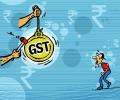
Over 100,000 small and medium-sized businesses are non-compliant with e-invoicing norms under the goods and services tax (GST) regime, a mandatory requirement for businesses with an annual turnover of over Rs 5 crore. E-invoicing provides real-time access to invoices that are prepared by the supplier on the purchase of goods, allowing faster accessibility to input tax credit, thereby limiting the manipulation of fake credit as it has to be generated before the transaction. "The default has been reported mainly in businesses with a turnover between Rs 5 crore and Rs 20 crore," a senior official informed

Investors are increasingly turning optimistic about shares of new-age companies. From broad-based 'sell' calls, analysts are giving thumbs up to Zomato, Paytm, and FSN e-Commerce Ventures-owned Nykaa as these companies have shifted focus to sustainable profits. The shares of Zomato hit a fresh 52-week high of Rs 126 apiece on the BSE on November 7, having rallied 15.4 per cent in one week.

Taking both direct and indirect taxes, the gross collection is expected to grow 10.45 per cent to Rs 33.61 trillion in 2023-2024.

The stock of State Bank of India (SBI) may re-rate soon, believe analysts, if the lender manages to safeguard its net interest margin (NIM) going ahead. This, along with controlled credit costs, should aid the outlook of the stock which has been underperforming the markets for some time now. "We believe delivery of growth on guided lines, sustenance of NIMs near current levels, and controlled asset quality parameters aiding controlled credit costs should lead to strong profitability and drive re-rating of the stock," said analysts at JM Financial.
 © 2025 Rediff.com - Investor Information - Advertise with us - Disclaimer - Privacy Policy - Sitemap - Feedback - About us - Terms of use - Grievances